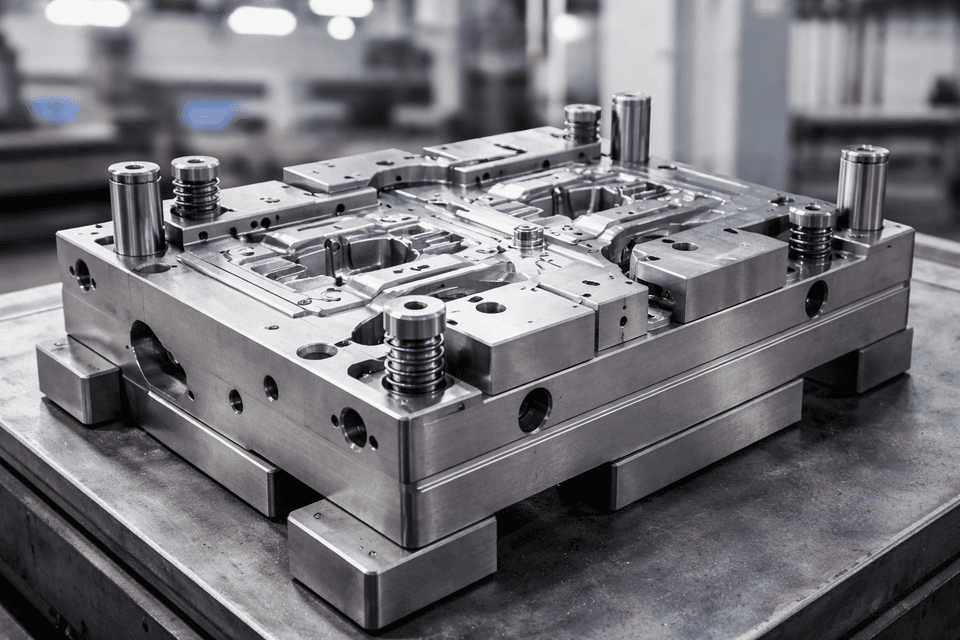
Definition and function of the die
A die, often referred to as a forming tool, is a specialized tool used in manufacturing technology to shape materials into defined forms using pressure, heat or other forces. It is essential for processes such as punching, forming, injection molding and many other production methods.
Although the terms “die” and “matrix” are similar in sound, they are fundamentally different in context. A die in manufacturing technology refers to a physical tool for shaping materials. In contrast, a matrix in mathematics describes a rectangular arrangement of numbers, symbols or expressions organized in rows and columns. It is important to make a clear distinction between these terms to avoid misunderstandings.
Types of dies in production engineering
There are different types of matrices depending on the requirements:
1. Punching dies
Punching dies are used to shape materials, usually metal sheets, into specific shapes by embossing or cutting. They consist of a die and a counter tool, the punch, which work together to cut out the desired part from the raw material. This process enables the fast and precise production of components in large quantities.
Forming dies are used in processes such as bending, deep drawing or rolling. They change the shape of a material without significantly altering its volume. This is particularly important in metal processing, where precise shape changes are required to produce complex components.
3. Injection mold dies
In the injection molding process, liquids, usually plastics or metals, are injected into a die, where they cool and harden. This type of die requires a high degree of precision as it has a significant influence on the shape and surface quality of the end product. Injection molds are particularly important for the production of complex and detailed plastic parts.
Production and design of dies
Materials
Choosing the right material for a die is crucial for its durability and precision. Commonly used materials are hardened steel, tool steel and special alloys that can withstand high temperatures and mechanical stress. These materials ensure that the die retains its shape and function even under intensive use.
Design processes
Dies are usually designed using CAD (computer-aided design) software. This enables precise planning and simulation of production processes, which minimizes errors and increases efficiency. By using modern software, complex matrices can be drawn and their behavior predicted under real production conditions.
Manufacturing technologies
The production of dies requires highly specialized machines and techniques. CNC (Computer Numerical Control) milling machines are particularly important here, as they guarantee high accuracy and repeatability. In addition, modern methods such as 5-axis milling are used to efficiently process complex geometries. These technologies enable the precise implementation of the designed matrices into reality.
Applications and areas of use
Automotive industry
In the automotive industry, dies are indispensable for the production of body parts, engine blocks and other components. By using dies, large quantities can be produced with high precision and consistency, which significantly improves the quality and reliability of vehicles.
Electronics
In electronics production, dies are used to manufacture housings, connections and other components. The high precision of the dies ensures that sensitive electronic components can be installed with an exact fit. This is particularly important to ensure the functionality and longevity of electronic devices.
Packaging industry
Dies also play an important role in the packaging industry, for example in the production of blister packs or quality-conscious containers. Precision and speed are crucial here in order to meet the high production requirements. Dies enable the rapid production of packaging that is both functional and aesthetically pleasing.
Conclusion
Dies are an indispensable part of modern production technology. They enable the precise and efficient production of a wide range of components in various industries. Through continuous innovation and the integration of new technologies such as Industry 4.0 and additive manufacturing, the die remains a central element that adapts to the changing requirements of industry. The future of manufacturing technology will be shaped to a large extent by the further development and optimization of dies in order to meet the increasing demands for quality, efficiency and sustainability.