Machining on 4–5 sides
5-Axis CNC Machining Center
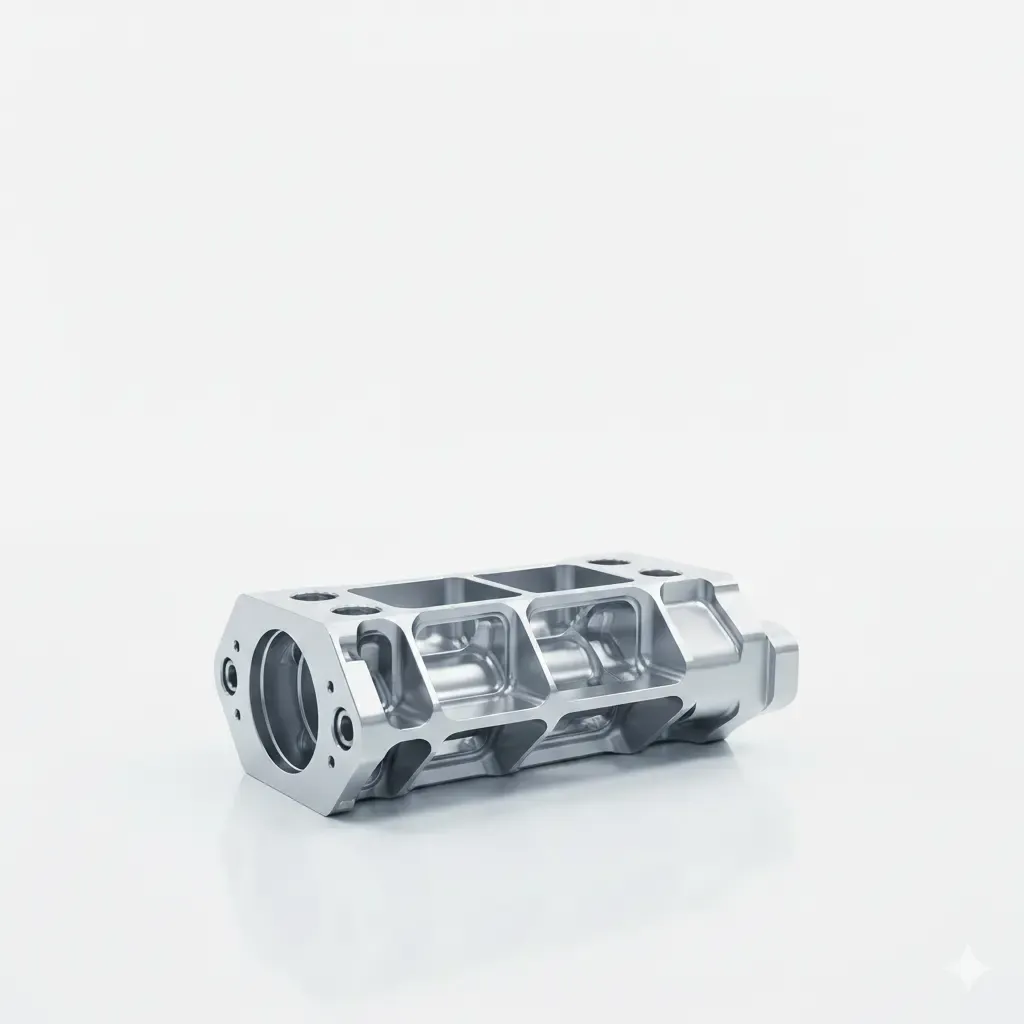
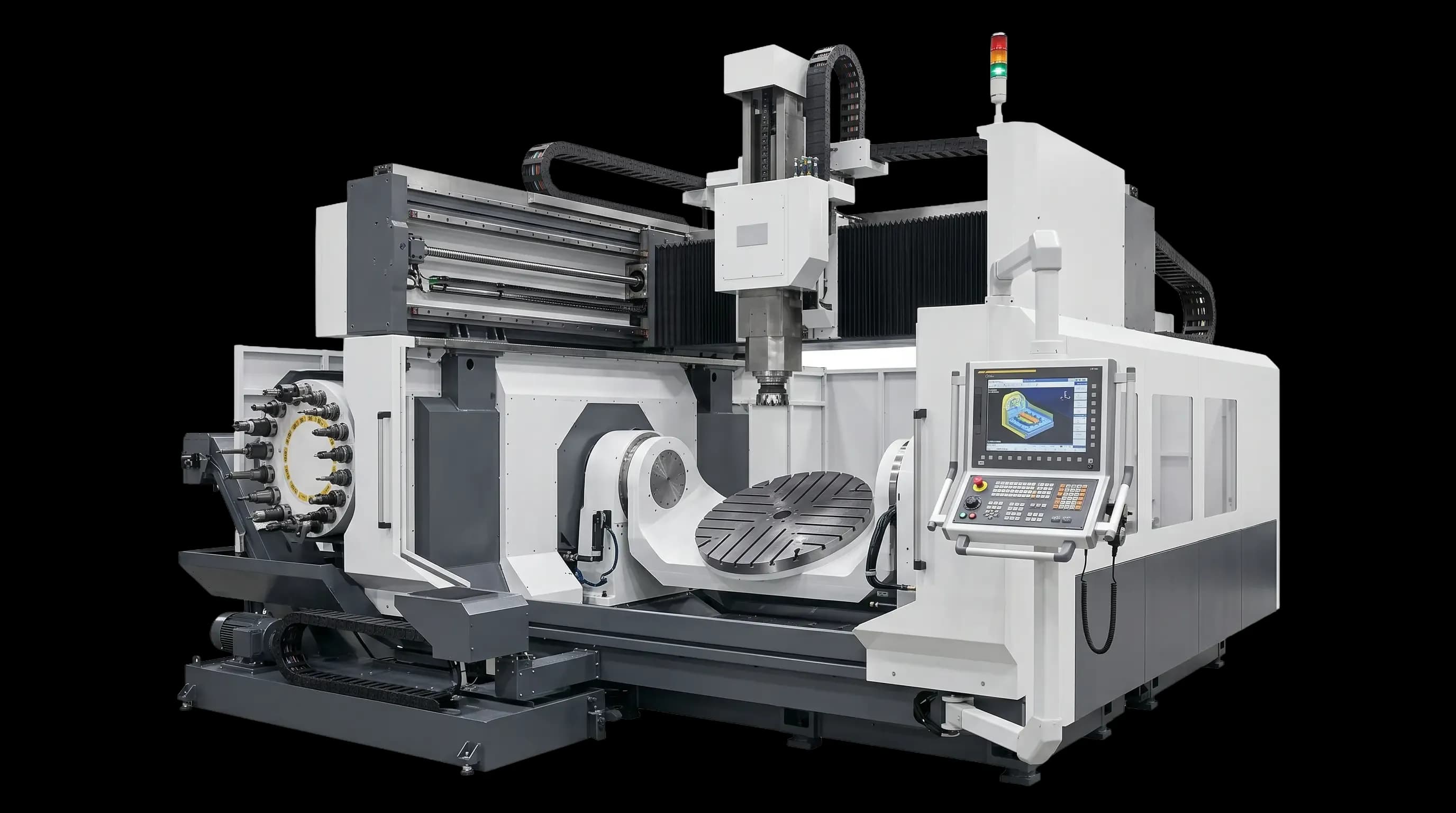
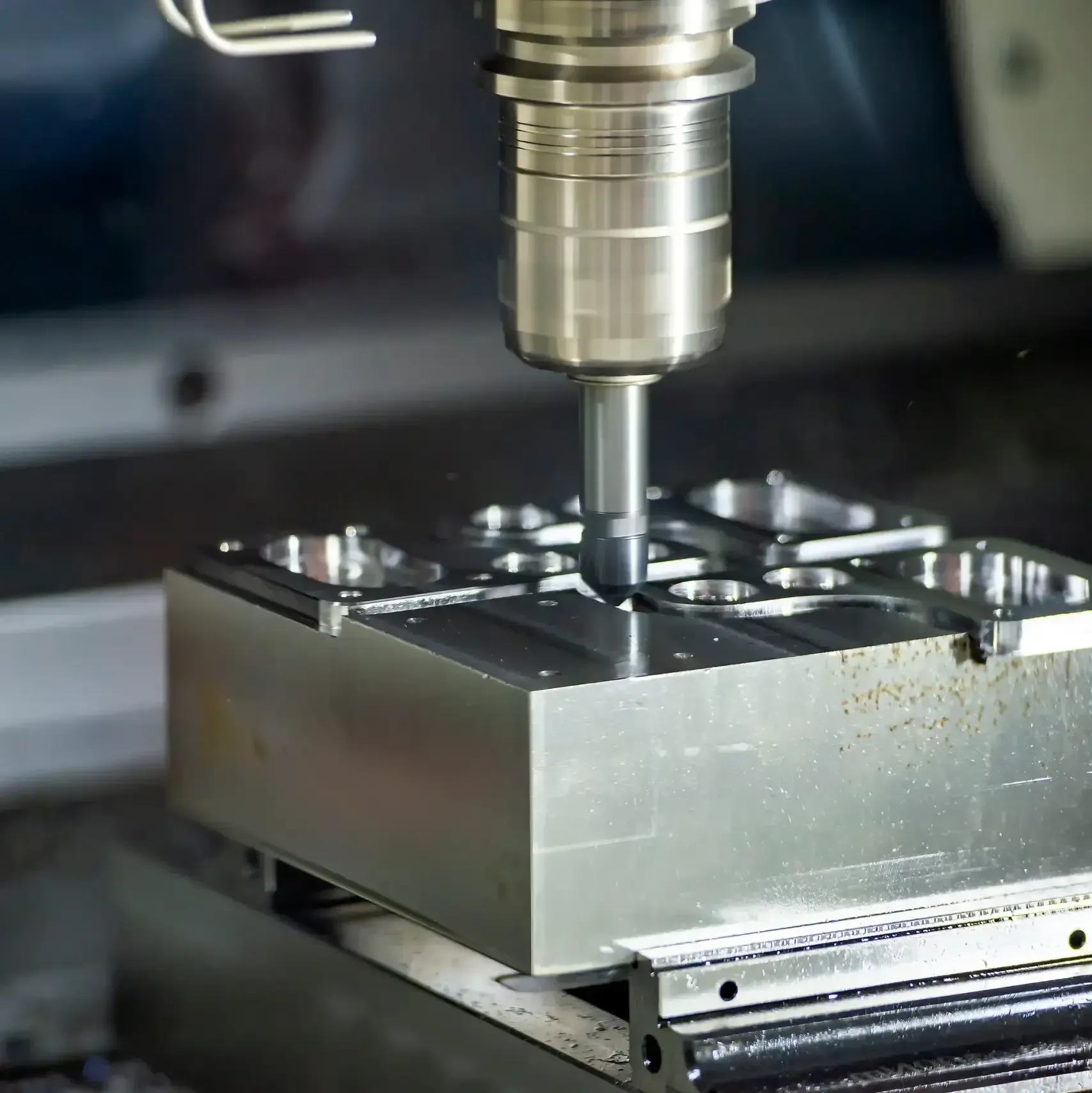
A high-quality 5-axis machining center creates the technical foundation for this. Through three linear axes and two additional rotary axes, workpieces can be machined from almost all relevant directions. Depending on the machine concept, both indexed 3+2 machining and simultaneous machining of all five axes are possible.
assemblean develops and produces CNC machining centers for industrial applications. The focus is not on the machine alone, but on the complete manufacturing process: from the workpiece spectrum through workholding, control systems and automation to economical integration into production.
Service overview
A conventional CNC machining center moves the tool along the three linear axes X, Y and Z. For many prismatic components, this is entirely sufficient. However, as soon as multiple sides, angled surfaces, undercuts, deep cavities or complex freeform surfaces need to be machined, the effort increases significantly. The workpiece must be re-clamped, realigned and re-measured multiple times. Every additional work step costs time and carries a risk of errors.
A 5-axis machining center supplements the three linear axes with two rotary or swivel axes. This allows the workpiece to be brought into almost any required machining position relative to the tool. It enables the machining of multiple workpiece sides in a single setup, better accessibility to complex contours, shorter and more stable tools, fewer re-clamping and alignment operations, higher geometric accuracy, shorter setup and lead times, as well as better conditions for automated CNC manufacturing.
However, the number of axes alone is not decisive. Multi-axis machining only becomes economical once machine kinematics, working envelope, spindle, control system, CAM system, workholding and automation concept match the actual workpiece spectrum. That is why assemblean does not view a 5-axis project as an isolated machine purchase. The technical design begins with the customer's components, materials, batch sizes and quality requirements.
Before turning to machining strategies, kinematics and machine design, it is worth looking at the components that make up a 5-axis machining center.
Precise, high-speed spindle for cutting forces and surface quality — the heart of every machining operation.
Your production benefits from five axes if these characteristics apply
Machining on 4–5 sides
Re-clamping causes deviations
Complex freeform surfaces & 3D contours
Deep cavities, long tools
Setup times limit capacity
Small batches, high flexibility
Automated, unmanned production
Multiple processes, one machine
Rising surface & repeat accuracy demands
Not every 5-axis machining center is used the same way for every machining task. In practice, a distinction must be made between indexed 3+2 machining and simultaneous 5-axis machining.
| Analysis parameter | 3+2 Machining | Simultaneous 5-Axis Machining |
|---|---|---|
| Motion Principle | The rotary axes position the workpiece. They remain stationary during milling. | Linear and rotary axes move simultaneously during machining. |
| Suitable Components | Multi-sided prismatic components, angled bores, pockets and defined machining planes | Freeform surfaces, turbine geometries, impellers, complex contours and continuously changing tool angles |
| Programming | Comparatively manageable | Higher requirements for CAM system, post-processor and simulation |
| Collision Risk | Tends to be lower | Requires precise digital machine simulation |
| Surfaces | Very good for flat, clearly positionable surfaces | Particularly suited to continuous, high-quality freeform surfaces |
| Investment Benefit | High benefit in reducing the number of setups | High benefit for complex geometries and demanding surfaces |
| Skills Required | Moderate | Higher, especially in CAM programming and process planning |
For numerous mechanical engineering components, 3+2 machining is already sufficient. The component is automatically brought into the appropriate position and then machined in three axes. This avoids many manual re-clampings without requiring all five axes to interpolate simultaneously.
Simultaneous machining is necessary when the tool orientation must change continuously during the milling process. It offers the greatest geometric degree of freedom, but also places higher demands on the entire process chain.
In machine design, assemblean therefore considers not only whether five axes are available. What matters is which machining strategy is needed for the specific workpieces and how reliably it can be implemented in day-to-day production later on.
Every setup costs productive time. On top of that come cleaning, alignment, zero-point determination and, where applicable, intermediate measurements. If a component can be manufactured in one or significantly fewer setups, setup effort and lead time decrease. At the same time, errors caused by repositioning are reduced. assemblean already considers during project planning how workpieces are to be clamped, measured and, where applicable, fed in automatically.
assemblean combines the technical performance of multi-axis machining with a project-specific design. The goal is not the most extensive equipment possible, but a configuration that reliably supports the specific manufacturing process.
The design starts with the workpiece: dimensions, weight, machining sides, materials, tolerances, batch sizes and planned automation.
Machine, tools, measurement technology, workholding and programming are coordinated so the process runs reproducibly.
Equipment options are evaluated by the concrete benefit they provide — protecting against unnecessary investment.
Automation options can be factored into the original machine planning from the outset.
The kinematics determine how the tool and workpiece move relative to each other. They influence working envelope, accessibility, dynamics, rigidity and permissible workpiece weight.
| Analysis parameter | Typical Suitability | Key Advantages | Points to Consider |
|---|---|---|---|
| Rotary-Tilt Table | Small and medium-sized, complex components | Good accessibility, dynamic positioning, compact design | Table load capacity and swing circle limit component size |
| Swivel Head | Large or heavy workpieces | Workpiece remains stable on the table, high flexibility for large components | Head design and rigidity must match the required cutting performance |
| Head-Table Combination | Broad workpiece spectrum | Distribution of rotary motion between tool and workpiece | Higher kinematic complexity |
| Portal or Gantry Concept | Large working envelopes and demanding workpieces | Good force distribution and high accessibility | Consider footprint, installation and infrastructure |
| Swivel Bridge | Compact, multi-sided machining | Good machinability of multiple sides | Check permissible component dimensions and workholding |
The right kinematics cannot be derived from the maximum workpiece diameter alone. What matters is the actually usable working envelope with swiveled axes.
assemblean evaluates these factors using real or representative workpieces. Such an assessment reduces the risk that a machine that is nominally large enough later reaches geometric limits in the actual process.
Parameters to Check
A workpiece may geometrically fit on the table and still collide with the spindle, workholding or machine paneling. That is why the following parameters should also be considered when making a selection:

In mechanical engineering, function-critical surfaces, hole patterns, fits and angled contours often need to be produced in a tight geometric relationship to one another.
A 5-axis machining center enables machining of multiple sides without repeated manual alignment — particularly relevant for single parts and small series. assemblean aligns the machine concept with the combination of part diversity, accuracy and an economical setup strategy.

Mold inserts, electrodes, cavities and freeform surfaces place high demands on surface quality and tool guidance. The variable tool orientation makes it possible to achieve favorable engagement conditions and partly avoid long tools. assemblean takes into account both machine-side precision and the requirements for the digital process chain and tool management.

Contract manufacturers need to respond flexibly to changing components, materials and batch sizes. Important selection criteria include a universal working envelope, flexible clamping options, sufficient tool capacity, various machining strategies, fast changeover and high availability. assemblean aligns the configuration with the expected part spectrum.

Prototypes, fixtures, molds and complex series components require short response times and reproducible processes. The combination of 5-axis machining, automated loading and integrated quality control can create a significant productivity advantage here.

Components made of aluminum, titanium or high-strength alloys combine complex geometries with high documentation and quality requirements. The machine must reliably handle both dynamic finishing operations and robust roughing processes.
For this, assemblean considers spindle design, machine rigidity, cooling and process monitoring together.

Implants, instruments and precision components often have complex contours and high requirements for surfaces and repeatability. A stable, well-controlled overall process is crucial — alongside the machine, this also includes tool management, measurement technology and documented machining sequences.

Impellers, rotors and flow-optimized components are typical applications for simultaneous precision milling. A powerful CNC control, a validated post-processor and realistic collision simulation are indispensable here.
A rigid base structure reduces deformation under load and improves vibration behavior. assemblean aligns structure, guideways, drives and spindle with the intended performance range.
Errors in rotary or swivel axes have a direct effect on the contour and position of the workpiece. Important criteria include:
For aluminum, speed is often the deciding factor; for steel and heavy machining, it is the available torque. assemblean dimensions the spindle based on real machining cases. Relevant factors include:
A magazine that is too small causes frequent operator intervention, while an oversized magazine increases cost and space requirements. Magazine size depends on:
For simultaneous processes, fast block processing and look-ahead path control are essential. The control system should also match the knowledge already available within the company.
Touch probes and tool measuring systems reduce setup times and increase process reliability. They support:
Inadequate chip removal can damage tools and limit automated runtimes. Depending on the material, the following are relevant:
A high-performance 5-axis CNC requires a correspondingly well-designed digital process chain. Especially with simultaneous tool paths, small deviations in the post-processor or kinematic data can have significant consequences. assemblean incorporates the following questions into project clarification to ensure a controlled transition from digital planning to a safe real-world process.
Safe Programming Includes
Important Questions for the Machine Manufacturer
A manufacturer should therefore not only consider the mechanical machine, but also clarify:
A 5-axis machining center can machine a broad spectrum of metallic and non-metallic materials. Actual performance depends on the spindle, machine structure, tools, cooling and machining strategy.

Aluminum allows high cutting speeds and feed rates. This often requires high spindle speeds, good dynamics and effective chip removal. Typical applications include structural components, fixtures, prototypes, housings and components for aerospace and mobility.

For steel, rigidity, torque and thermal stability are particularly important.

Stainless steel additionally places high demands on tools, cooling and process control.

These materials are difficult to machine and generate high thermal and mechanical loads. Requirements include, among others, high machine rigidity, a robust spindle, controlled cooling, stable tools and adapted cutting strategies.

Engineering plastics can be machined precisely but react differently to heat, stress and chip formation. Suitable tools and extraction or chip removal systems are crucial.

CFRP and GFRP require matched tools and a reliable dust and extraction concept. Protective measures for the machine and operating personnel must also be taken into account.

For model-making boards, foams or composite materials, high dynamics and large-volume working envelopes can be the priority. assemblean designs the machine performance based on the intended material groups, so that spindle, cooling concept and peripherals are defined by the actual machining requirements.
A 5-axis machining center offers good conditions for automated production, since many machining operations can be consolidated into a single setup.
| Analysis parameter | Typical Solution | Suitable For |
|---|---|---|
| Manual Loading | Direct operation by skilled personnel | Single parts, prototypes and frequently changing components |
| Pallet Changer | Switching between prepared pallets | Recurring parts and small series |
| Pallet Pool | Several prepared workpieces or orders | Variant production and extended runtimes |
| Robot Loading | Automatic workpiece handling | Series production and unmanned time windows |
| Flexible Manufacturing Cell | Machines, storage, tools and control system | High variant diversity and networked production |
Automation does not begin with the robot. First, the machining process must be sufficiently stable. assemblean can take automation into account as part of the overall machine concept — even if the initial setup is manual, future expansions can be factored into the planning at an early stage.
Prerequisites for a Stable, Automatable Process
Reproducible raw parts
Reliable workholding
Sufficient tool life
Tool breakage monitoring
Automatic measuring routines
Reliable chip removal
Defined fault-handling strategies
Selection does not begin with a model designation, but with your workpiece, your materials and your batch sizes.
Structure, kinematics, control system, workholding, measurement technology and automation are considered as one integrated system.
Precision is achieved under real production conditions — not through a single brochure figure.
We evaluate every equipment option by the concrete benefit it offers your process.
From project clarification through commissioning to training your staff.
Availability, maintainability and spare parts supply protect the value of your investment for years to come.
A 5-axis machining center generally involves higher investment costs than a simpler 3-axis machine. A robust assessment must therefore not stop at the purchase price. What matters are the total costs per component produced.
01
02
Assume a component has so far required three setups on different machines. Including transport, cleaning, alignment and intermediate inspection, this results in several hours of unproductive time per batch.
If the component can in future be machined largely in a single setup, savings arise not only in milling time. Equally relevant are:
03
Working with assemblean is particularly worthwhile when:
Process
A clear flow, one point of contact, and a well-coordinated manufacturing process.
Workpieces, materials, tolerances, batch sizes and planned machining strategies are recorded.
Kinematics, working envelope, spindle, control system and tool capacity are aligned with the requirements.
Workholding, CAM, post-processor, measurement technology, automation and facility infrastructure are taken into account.
Critical machining areas, potential collisions and required performance reserves are examined.
Installation, utility connections, transport routes and training needs are planned.
After commissioning, operators and programmers are familiarized with the machine and the process. Depending on the project, initial workpieces or machining sequences can be implemented jointly. This structured approach helps purchasing and management secure the investment not only technically, but also organizationally and economically.
Before making an investment decision, at least the following points should be clarified. assemblean supports the structured capture of these requirements and derives a suitable machine concept from them.
FAQ
A 5-axis machining center is a CNC-controlled machine tool with three linear and two rotary axes of motion. This allows complex components to be machined from different directions without manually re-clamping them for each side.
In 3+2 machining, the two rotary axes position the workpiece in a fixed orientation. Milling is then performed in three axes. In simultaneous machining, all required axes move at the same time. It is mainly used for freeform surfaces and continuously changing tool orientations.
It is particularly worthwhile for multiple machining sides, high setup times, tight positional relationships, complex geometries or high automation potential. For simple components, a 3-axis machine can still be the more economical solution.
The starting point is workpiece dimensions, weight, materials, tolerances, batch sizes and machining strategies. Kinematics, working envelope, spindle, control system, tooling concept and possible automation are then aligned accordingly.
Yes, the technical design can be aligned not just to a single reference component, but to a defined workpiece spectrum. This requires sufficient performance and working envelope reserves without unnecessarily oversizing the machine.
Typical materials include aluminum, steel, stainless steel, titanium, nickel-based alloys, engineering plastics and fiber-reinforced composites. The suitable machine configuration depends significantly on cutting forces, speed requirements, heat generation and chip behavior.
The spindle should be selected based on the real machining task. What matters is not just maximum speed and power, but also torque curve, continuous power, tool holder and cooling. These criteria can be taken into account as part of technical project clarification.
Automation options can be factored in as early as machine planning. Depending on the manufacturing task, pallet solutions, workpiece storage or robot concepts, for example, may be suitable. The prerequisite is a stable and monitorable machining process.
In a 5-axis project, the CAM system, machine-specific post-processor and digital collision simulation should be coordinated early on. The specific scope of support is defined within the project and adapted to the customer's existing software environment.
A rigid machine structure, precise measuring systems, thermal stability, careful assembly and regular kinematic verification are decisive. In addition, workholding, tools, CAM strategy and ambient conditions influence the actual machining result.
In addition to the machine, costs may arise for workholding, tools, measurement technology, CAM adaptations, post-processor, automation, transport, rigging, training and infrastructure. A transparent project calculation should capture these items early on.
Commissioning is an important part of the production start. The specific scope of services can include installation, functional testing, instruction and support during ramp-up, and is agreed on a project-specific basis.
Relevant training covers machine operation, CNC control, safe setup, measurement technology, maintenance and — for simultaneous processes — CAM programming. Scope and focus should be adapted to employees' experience.
For this, current setup times, number of setups, machining times, personnel costs, scrap and utilization are compared with the planned 5-axis process. assemblean can incorporate this assessment into the consultation based on real manufacturing data.
Knowledge hub


Investing in a 5-axis machining center affects productivity, component quality and manufacturing flexibility for many years to come. A well-founded decision therefore does not begin with a general product comparison, but with a precise analysis of your manufacturing task.
In a consultation with assemblean, we work together to clarify which machine kinematics suit your components, which performance data are actually needed, how existing processes can be simplified, which automation options make sense, how the machine can be integrated into your production, and what economic benefit is realistically achievable.
Discuss your project with assemblean.
Trusted by
Book a personal meeting
Contact us now
© assemblean 2026 | All rights reserved.