

Automated & semi-automated assembly lines
Economic scaling from operator-guided workstations to unmanned production. Custom levels of automation for every production requirement.
Custom Machine Building
While standard machines are designed for a broad range of standard tasks, custom machine building begins precisely where series production reaches its technological or economic limits. As experts in complex assembly systems, our offering is structured around three main technological areas.
Assembly is often the most complex and labour-intensive step in the value chain. Custom machine building focuses on bringing components together in a process-reliable, cycle-consistent and ergonomic way — from manual handling support to unmanned lights-out production.
Economic scaling from operator-guided workstations to unmanned production. Custom levels of automation for every production requirement.

Optimised for minimum cycle times or maximum variant diversity with fast changeover times. Ideal for variant-rich series production.

Smart kinematics and high-speed assembly systems for precise part handling at second-by-second rates. Integrable into existing lines.

Comprehensive project management from the first simulation through to production-ready handover including software and commissioning.
While an assembly line focuses on joining parts, a production line covers the entire manufacturing cycle of a component — from material feeding to final inspection. Custom machine building solves the challenge of linking diverse machining processes so that a smooth material flow is achieved.

Networked, highly automated manufacturing systems that connect material flow, machining, assembly and inspection into one continuous value-creation process. For maximum equipment availability and short lead times.

Custom-tailored production lines for maximum output at short cycle times – from capacity planning to turnkey commissioning.

Flexible production lines for frequently changing products and small batch sizes – economically viable through short changeover times and modular process stations.
Within every production or assembly line, specific machines carry out their core tasks. When standard machine tools are insufficient for your specific requirements, custom machine building develops and integrates highly specialised individual systems.
For components requiring the highest dimensional accuracy and complex geometries, we integrate advanced CNC technology — from large-volume heavy engineering workpieces to precision small parts.

5-axis machining centres
Learn more
CNC turn-mill centres
Learn more
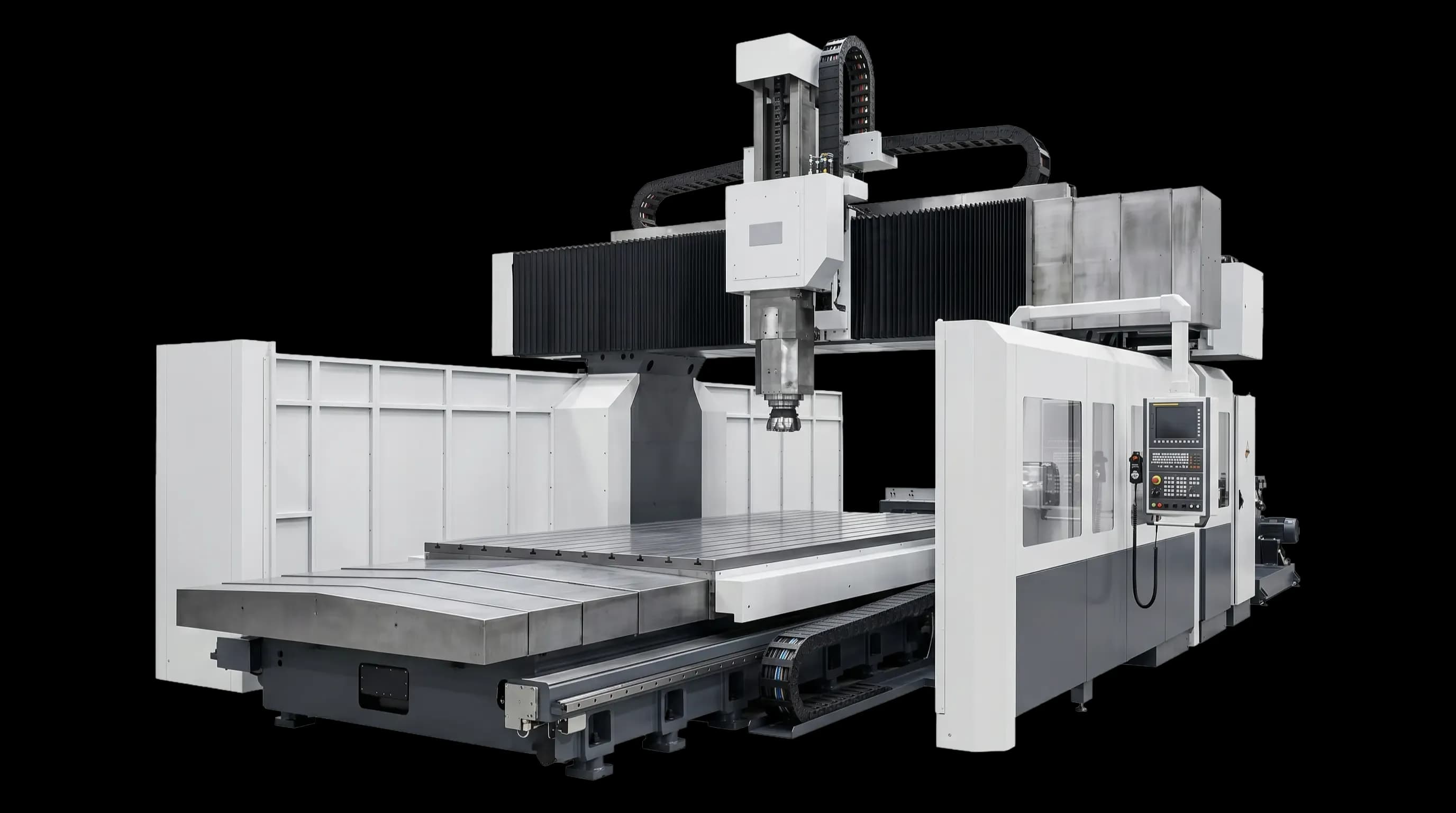
Gantry milling machines
Learn more
CNC sliding-head lathes
Learn moreFully automated and robot-assisted joining processes that deliver reproducible top quality at the shortest cycle times, even with demanding materials (aluminium, copper, mixed joints).

Automated laser welding systems

Robot-assisted welding cells

Ultrasonic welding systems

Friction stir welding systems (FSW)
When conventional milling or turning processes reach the limits of material hardness or extreme surface finishes are required, high-precision material-removal processes are deployed.

Surface grinding machines for large parts

Cylindrical grinding automatics

Wire EDM machines

Die-sinking EDM machines
Efficient shaping and targeted thermal treatment of metallic materials. Seamlessly integrable into the production flow.

Laser cutting systems for sheet metal

CNC press brakes

Induction hardening systems
Process
A clear flow, one point of contact, and a well-coordinated manufacturing process.
The starting point is an analysis of the product and the desired cycle time. This produces an initial system concept with an assessment of technical and economic feasibility.
3D simulations and kinematic studies (digital twins) help validate the material flow and rule out collisions before a single part is manufactured.
The mechanical design and electrotechnical layout are developed in full detail. All components are checked for function, maintainability and safety.
PLC and robotics programming breathes life into the system. Interfaces to upstream and downstream systems are prepared and tested.
After the internal test run (FAT — Factory Acceptance Test), the system is installed at the customer site and finally accepted under real production conditions (SAT — Site Acceptance Test).
Every successful custom machine begins with a clear understanding of the production engineering goals. Whether you are planning a new assembly line, want to link your production processes, or need a highly specific special-purpose machine — the assemblean engineering team accompanies you from the first feasibility study through to successful commissioning.
Trusted by


Book a personal meeting
Contact us now
© assemblean 2026 | All rights reserved.