
Value stream analysis & layout optimization
We analyze material flow, cycle times, and bottlenecks and optimize the system layout before the first component is selected.
Automated Production Lines
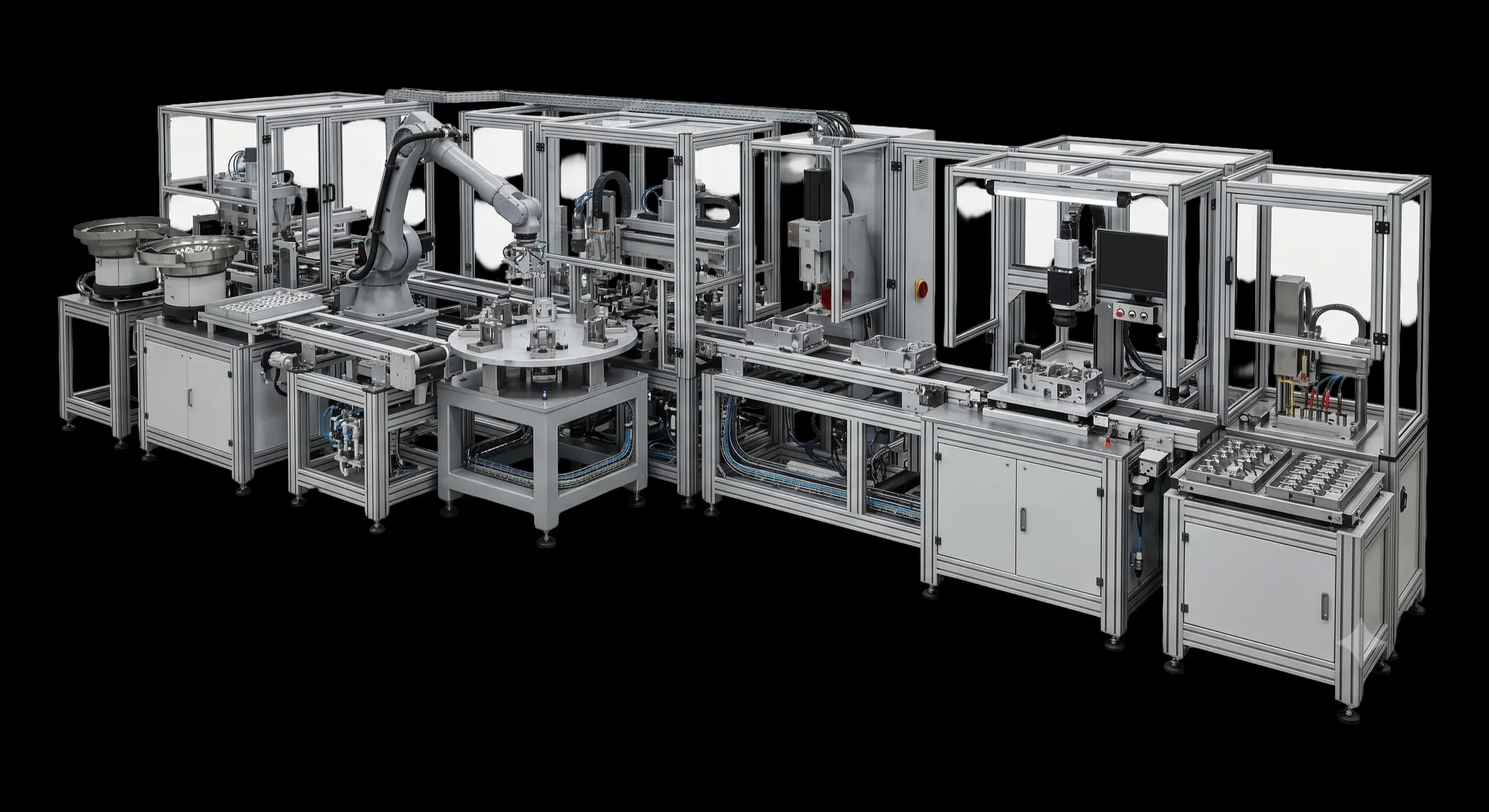
assemblean develops manufacturer-independent, highly automated production lines for companies that want to reduce lead times, avoid downtime, and set up their manufacturing to scale. Our solutions combine mechanical engineering, robotics, control technology, intralogistics, inline quality inspection, and industrial software into a powerful overall system.
Service overview
Automated production lines increase competitiveness because they make production processes faster, more stable, and more transparent. Companies benefit from shorter cycle times, less scrap, higher equipment availability, and better production planning. Especially in markets with high cost pressure, high-variant products, and rising quality requirements, intelligent production automation is decisive. It makes it possible to respond flexibly to new product generations, fluctuating demand, and individual customer requirements.
Automated production lines deliver measurable advantages along the entire value chain – from lead time and quality through to cost.
| Analysis parameter | Advantage | Technological Lever |
|---|---|---|
| Lead Time | Shorter production times and less idle time | Linked processes, intelligent conveying, AMRs |
| Quality | Consistently high product quality | Inline inspection, AI vision, sensor technology |
| Availability | Fewer unplanned downtimes | Predictive maintenance, SCADA, real-time data |
| Flexibility | Faster changeover on variant switches | Modular system concepts, recipe management |
| Transparency | Complete manufacturing data in real time | OPC UA, edge computing, ERP/MES connection |
| Cost | Less scrap, energy loss, and rework | Closed-loop control, smart yield engineering |
We view every production line as a cyber-physical overall system. What matters is not only automating individual work steps, but optimally connecting all processes into a stable, scalable, and data-driven production flow.
We analyze material flow, cycle times, and bottlenecks and optimize the system layout before the first component is selected.
Linked processes, intelligent conveying technology, and AMRs ensure a continuous, low-loss material flow across the entire line.
We develop the PLC, edge, and SCADA architecture and connect your line to MES, ERP, and cloud systems via OPC UA.
Digital twins and hardware-in-the-loop tests validate cycle times and interfaces before a single part is produced.
From mechanical assembly through training to production ramp-up, we support your line to validated series readiness.
Existing machines are integrated into modern, networked manufacturing via IoT gateways, retrofitting, and supplementary sensor technology.
Modern production lines use a combination of proven industrial automation and intelligent digital technologies that grow together into a synchronized production system.

Industrial robots, gantry systems, and collaborative robots handle handling, joining, and inspection with high repeatability.

Automated guided vehicles, modular conveyor systems, and buffer solutions provide flexible, scalable intralogistics.

PLC and edge controllers as well as SCADA systems monitor and control the line in real time across all stations.

AI-based 2D/3D camera systems and multi-sensor technology detect surface defects, geometric deviations, and assembly errors directly in the flow.

Standardized interfaces bring process, quality, and condition data transparently together into your IT landscape.

Condition monitoring, predictive maintenance solutions, and digital twins prevent downtime and accelerate commissioning.
Automated production lines are suited for all industries where quality, speed, repeatability, and scalability are decisive. Among others, assemblean delivers solutions for:

In battery and e-mobility production, process reliability, precision, and controlled ambient conditions count. Automated lines produce cell, module, and pack systems with high repeatability.

In consumer electronics and high-tech production, short cycle times, ESD protection, and micro-precision are decisive. Automated systems ensure precise handling, reliable inspection, and high volumes.

For solar, wind, and energy systems, large, sensitive, or complex components are often processed. Automated lines combine robust handling with precise sensor technology and reliable quality control.

For sustainable packaging systems, automated systems enable the processing of new materials, adaptive sealing processes, and high production speeds with stable quality.
Process
A clear flow, one point of contact, and a well-coordinated manufacturing process.
Analysis of existing manufacturing and definition of material flow, cycle times, bottlenecks, quality requirements, and scaling goals.
Optimization of value stream and layout as the basis for a viable automation concept.
Development of the system and IT architecture and simulation of material flow, cycle times, and bottlenecks.
Selection and integration of suitable technologies, virtual commissioning, and interface tests.
Mechanical build-up, electrical integration, software development, SCADA, and IT connection.
Commissioning, training, production ramp-up, and continuous optimization during operation.
If the system detects deviations, it can adjust parameters, eject defective parts, or report maintenance needs. This creates manufacturing that is not only automated, but increasingly self-optimizing.
Process data is used in real time to detect bottlenecks, quality deviations, and energy losses early. The line adjusts transport speeds, reroutes material flows, or reports tool wear directly back – for higher OEE and less scrap.
AI-based vision systems detect surface defects, geometric deviations, and assembly errors in the flow. Machine learning models identify patterns that indicate impending failures or quality problems.
Separated IT and OT networks, firewalls, network segmentation, encrypted communication, role-based access, and secure VPN solutions protect networked production lines on multiple levels.
Modular system concepts, standardized interfaces, and central recipe management enable a fast switch to new product generations without redeveloping the entire line.
assemblean combines mechanical engineering, automation, software, and manufacturing understanding into holistic production solutions. We do not develop isolated single machines, but continuous production lines precisely aligned with your products, processes, and growth goals.
Manufacturer-independent system concepts and continuous end-to-end process linking instead of isolated point solutions.
Robotics and handling expertise combined with intelligent, scalable intralogistics.
AI-based inline quality inspection as well as scalable control and SCADA systems for full process transparency.
Digital simulation, virtual commissioning, and brownfield integration of existing machines into modern manufacturing.
The first step is a sound analysis of your current manufacturing. Together we examine material flow, cycle times, bottlenecks, quality requirements, and scaling goals. From this we develop an automation concept that is technically feasible, economically sensible, and expandable in the long term.
Talk to assemblean about your automated production line and learn how you can reduce lead times, secure quality, and make your manufacturing future-proof.
FAQ
A production line usually describes a linearly linked sequence of processing steps. A production system can be more comprehensive and encompass several lines, robot cells, inspection systems, intralogistics, control technology, and IT connections.
An automated production line is worthwhile when high volumes, recurring processes, quality requirements, skilled labor shortages, or rising cost pressure limit manual manufacturing.
Yes. Modern production lines are developed modularly and precisely aligned with product, process, cycle time, material flow, and available floor space.
The duration depends on complexity, number of processes, degree of integration, and existing infrastructure. Realistic project planning emerges after analyzing product, layout, cycle time, and interfaces.
They provide, among other things, process data, quality data, condition data, energy consumption, downtime reasons, OEE metrics, and maintenance information.
Yes, if the line is planned modularly and flexibly. Especially in high-variant manufacturing, robots, AMRs, and digital recipe management can create economic advantages.
Employees increasingly take on monitoring, controlling, and optimizing tasks. Training, intuitive user interfaces, and clear process visualization ease the transition.
Knowledge hub


Trusted by


Book a personal meeting
Contact us now
© assemblean 2026 | All rights reserved.