Dictionary
Burn marks (injection molding)Dictionary
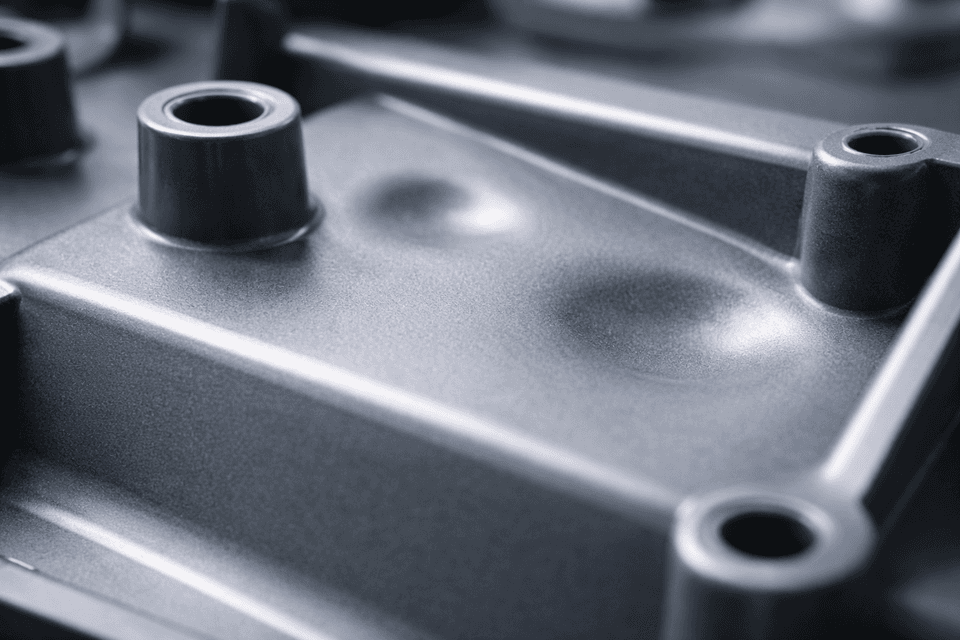
EnglishShort definitionSink marks are localized depressions on the surface of injection-molded parts, typically appearing above thick sections, ribs, or bosses when the material cools and shrinks unevenly. They affect appearance and dimensional stability and are often reduced by optimizing holding pressure, wall thickness, cooling, and gate design.
Dictionary
Burn marks (injection molding)Burn marks in injection molding appear as dark brown or black areas on molded parts when plastic or trapped air overheats during filling, often near the end of the flow path. They usually indicate poor venting, overly aggressive process settings, or problematic flow geometry and can affect both appearance and material integrity.
Dictionary
Injection molding parametersInjection molding parameters are the specific settings and conditions that are defined in the injection molding process to control the production of plastic parts. These include die and plastic temperatures, injection pressure, injection speed, dwell time and cooling times. The precise setting of these parameters is crucial for the quality and consistency of the parts produced, as they influence factors such as surface quality, dimensional accuracy and material properties. In practice, optimally tuned injection moulding parameters enable efficient production, reduce scrap rates and improve material utilization. They are therefore of great importance both from an academic perspective and in industry in order to produce competitive and high-quality plastic products.
Dictionary
Injection MoldingInjection molding is a manufacturing process in which molten material - usually plastic or metal - is injected into a mould or tool under high pressure. This process is mainly used in plastics and metal processing to produce precise and complex components in large quantities. Injection allows detailed shapes to be produced with tight tolerances and consistent quality, which is essential for series production. The technology enables efficient production processes, reduced material waste and quick changeover between different product variants. In industry, injection plays a central role in the production of components for the automotive, electronics, consumer goods and many other sectors. The optimization of the injection process contributes significantly to the competitiveness and innovative capacity of manufacturing companies.
Dictionary
Flash (burr)Flash, also called burr, is a thin layer of excess material that forms along parting lines or ejector areas when molten material escapes from the mold cavity. It affects dimensional accuracy and surface quality and is usually caused by excessive injection pressure, insufficient clamping force, mold wear, or poor tool fit.
Dictionary
Weld lines (knitting lines)Weld lines, also called knitting lines, are visible linear areas on injection-molded parts where two melt fronts meet but do not fuse completely. They can reduce local mechanical strength and visual quality, especially around holes or complex flow paths, and are influenced by melt temperature, tool design, venting, and flow balance.
Dictionary
FluidityFluidity describes the ability of a material to deform or flow under certain conditions. In the manufacturing industry, flowability is crucial for processes such as casting, injection molding and extrusion, as it influences the formability and surface quality of the end product. High flowability allows the material to be evenly distributed in complex shapes and reduces the occurrence of defects such as shrinkage cavities or cracks. From an academic point of view, flowability depends on factors such as temperature, viscosity and shear stress. In practice, optimizing flowability is essential to ensure efficient production processes, enable material savings and maximize product quality, which ultimately strengthens a company's competitiveness.
© assemblean 2026 | All rights reserved.