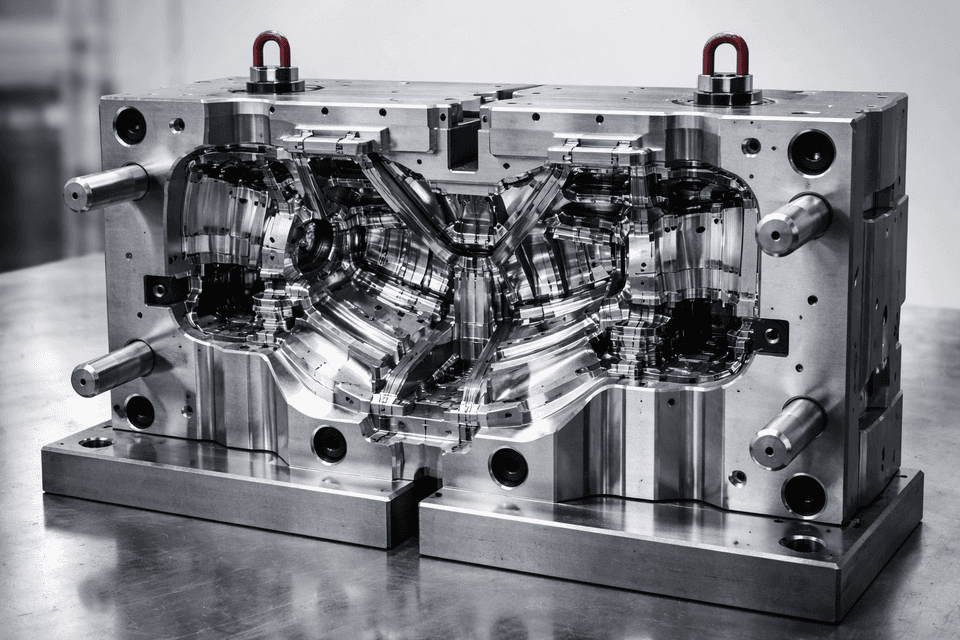
Definition and Functionality of a cavity
A cavity in mechanical engineering refers to the cavity within the injection moulding tool into which the molten plastic material is injected. It forms the shape of the component to be produced and is therefore crucial to its geometric properties.
Main functions of the cavity
1. Moulding: The cavity defines the external shape and internal structures of the injection moulded part. Any nuance of the cavity is transferred directly into the finished product.
2. Material guidance: In addition to the actual shape, the cavity also serves to effectively guide the plastic material through the tool to ensure uniform filling and distribution.
3. Heat removal: A well-designed cavity supports the efficient dissipation of the heat generated during injection molding, which shortens the cooling time and increases the production speed.
Design of the cavity
Cavity design is a complex process that requires precision and in-depth technical knowledge. Several factors must be considered to ensure optimal function and quality of the parts produced.
• Number and distribution of cavities:
Multiple cavities can be integrated in an injection moulding tool to increase the production volume. The number of cavities significantly affects the production capacity and cycle time. An even distribution of cavities in the mould is crucial to ensure uniform filling and cooling, which in turn ensures the quality of the parts produced.
Types of cavities
Depending on the requirements and production volume, there are different types of cavities:
1. Single cavities: These consist of a single hollow mold and are ideal for producing small series or prototypes. They allow high flexibility in the design of individual parts.
2. Multiple cavities: With multiple hollow molds in the same tool, larger quantities can be produced in a shorter time. This is particularly advantageous in mass production.
3. Family cavities: These combine different hollow shapes within a tool to produce different parts at the same time. This reduces toolmaking effort and optimizes production processes.
Practical applications of cavities in injection moulding
Cavities are used in a variety of industries and applications, from automotive to medical technology. Their design and optimization have a direct impact on production efficiency and the quality of the end products.
• automotive industry:
In the automotive industry, cavities are used to manufacture complex components such as panels, mounts, or interior components precisely and in large quantities. The ability to integrate multiple cavities into one tool enables efficient production while maintaining high quality standards.
• medical technology:
Medical technology requires extremely precise and sterile components. Family cavities allow different components of a medical device to be manufactured simultaneously, thereby shortening production times and improving the consistency of parts.
• Electronics and consumer goods:
In the electronics industry, cavities are used to produce casings and internal structures of devices. The high precision and repeatability of the injection molding process are critical to ensure the functionality and aesthetics of the products.
Challenges and solutions in cavity design
The design of cavities is associated with various challenges that need to be addressed by innovative methods and technologies.
• Uneven filling and warping:
Uneven filling of the cavity can lead to warping or internal stresses in the finished part. Careful design of injection points and optimized temperature management can minimize this problem.
• Tool wear and maintenance:
High production rates lead to significant mechanical stresses on cavities, which increases tool wear. Using wear-resistant materials and regular maintenance are essential to extend tool life and reduce production costs.
• Cooling channel optimisation:
Effective cooling is critical for cycle time and part quality. The arrangement of the cooling channels within the cavity must be designed to ensure uniform heat dissipation to avoid warping and discoloration.
Technological advances and innovations
The continuous evolution of injection molding technologies has led to significant improvements in cavity design. Some of the notable innovation areas include:
• 3D printing in mould construction:
The use of 3D printing technologies in mold manufacturing enables the rapid and cost-effective production of complex cavities. This technology offers flexibility in the design phase and significantly shortens development times.
• Simulation and digital tools:
Modern simulation tools enable virtual modeling and optimization of cavities prior to physical tool construction. Digital analysis allows potential problems to be identified and fixed early, increasing the efficiency and quality of production.
• Automation and robotics:
Integrating automation and robotics into the injection molding process improves the precision and repeatability of cavity assembly and maintenance. Automated systems reduce human error and increase production speed.
Quality assurance and control methods
Ensuring the quality of the injection molded parts begins with the cavity design and continues through the entire production process. Various methods and tools are used to monitor and continuously improve the quality.
• Statistical process control (SPC):
SPC methods enable real-time monitoring and analysis of production data. Through statistical analysis, deviations can be detected early and corrective action taken to ensure the consistency and quality of parts.
• Automated inspections:
Modern inspection systems utilize optical and sensory technologies to automatically check molded parts for defects and deviations. These systems greatly increase the precision and speed of quality control.
• Kaizen and continuous improvement:
Kaizen, a method of continuous improvement, is often used in the context of cavity design and production. By systematically identifying and eliminating waste and inefficiencies, production processes can be optimized and the quality of end products increased.
Conclusion
The cavity in mechanical engineering is a central part of the injection molding process and is crucial for the quality and efficiency of the components produced. Their precise design and optimization require a deep understanding of the technical requirements and continuous adaptation to new technologies and market requirements. Through the use of innovative methods such as 3D printing, simulation tools, and automated inspections, the future of the cavity in the injection molding process will be characterized by increasing efficiency, quality, and sustainability. Companies that adapt these developments early can secure a decisive competitive advantage and meet the growing demands of the market.